Reverse Unicorns: AI and Fiction Writing
By Glen C. Strathy
July 2026
If you're familiar with this site, you'll know I'm not a big fan of using artificial intelligence to generate text, a process that both plagiarizes other writers and robs aspiring writers of the opportunity to develop their own unique voice and improve their skills. Plus, putting my name on text I didn't write would feel like committing fraud.
That said, I recently was listening to an interview of Cory Doctorow in which he outlined his ideas on human vs. machine labour and the difference between a "unicorn" and a "reverse unicorn."
A "unicorn," according to Doctorow, means a person who uses a tool to improve their personal and creative endeavours. Think of someone who rides a bicycle to get where they want to go or an artist who uses a paint sprayer to create art. The tool or machine in such cases serves the human being.
A "reverse unicorn," on the other hand, is a person who serves the machine. Doctorow's example is an amazon worker who suffers stress and injuries from trying to keep up with robots in a warehouse.
So a writer who uses a typewriter, word processor, or speech-to-text software to improve their work while remaining in control of their schedule, vision, and other aims is being a unicorn. But a writer who feels obliged to use AI generated text in order to publish a "minimally viable" book every 90 days to meet the demands of amazon's algorithm and sell enough books to pay the bills is being a reverse unicorn. The quality of their life and their work is being compromised to meet the demands of the technology.
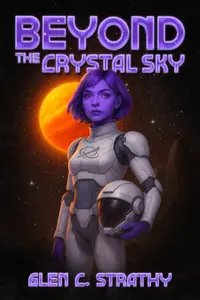
Now, I'm not sold on some of Doctorow's other ideas (e.g. those on copyright). But I've been pondering the boundary between unicorns and reverse unicorns recently as I've been experimenting with Spoken's audiobook generation tool to create an audiobook for my YA SF novel, Beyond the Crystal Sky.
Obviously, using AI to generate an audio performance rather than hiring a cast of human beings to perform the text is a compromise, though Spoken does not "steal" voices and pays some attention to ethical issues. Having worked as an actor, it bothers me that such tools may cost voice actors a lot of work, especially in nonfiction. Of course, you could also argue that the technology makes audiobook production affordable to many indie authors and publishers who cannot afford to hire human narrators. (Incidentally, I'm not being paid to promote Spoken, nor am I recommending their service.)
Spoken also has its limitations. It takes many hours to get the tool to produce a performance that comes close to how I want the book to sound. On the other hand, it offers some advantages over recording myself reading the text. I can have a narrator voice that sounds more like how I envision the main character as well as separate voices for other characters. Getting the right emotional tone, delivery, pronunciation, or even accent for each line is a challenge. But when it works, the results are pretty good.
But beyond the issue of whether one is a reverse unicorn (serving the tech), or a unicorn (using the tech to serve you), I think there's a third category: your own growth. For example, when I was young, children in public school would ask the teacher, "Why do we have to learn math when we can just use a calculator?" The answer, of course, is that you don't learn math just so you can get the right answers to problems like, "What will my mortgage payments be on this house?" (Because the bank will be happy to give you the answer.) You learn math to gain an understanding of the concepts behind math, to understand the logic behind how the universe works, so you can apply that logic to other endeavours in life.
Similarly, I don't use AI to generate story ideas, outlines, or text because that won't deepen my understanding of story structure or storytelling. It won't help me hone my skills with language. If I start depending on AI to "give me the answers," I might never be any better at writing than I am today.
Most writers learn through trial and error. They get ideas, and after pondering realize most of their ideas are terrible, and learn how to spot the gems. They wrestle with why a story isn't working, until they reach insights that help them solve the issue. They stare at a blank screen, uncertain how to say what they need to say, until the words finally come. They revise a story 5, 10, or 20 times until it feels right.
Letting an AI solve problems for you, in a blink of an eye, is tempting. But you'll never learn anything that way. At best, you'll be a publisher of generic, AI-generated text, not a writer. If that satisfies your aspirations, okay. But I think most aspiring writers aspire to become more, to grow artistically and intellectually. That's how they become worth reading.
Of course, my thinking may evolve. I may decide to forget about the whole AI experiment and stick to human narration. Or I might discover a way to use AI without sacrificing my artistic aspirations or taking away the challenges I need to grow.
If you'd like to hear what the result of my experiment with AI narration sounds like, I've released a free sample on DriveThruFiction. (It may not be there long.) Do let me know if you think the quality is adequate and what you think about such audiobooks in general.
UPDATE: I have begun to sour on the idea of AI narration, so I may not continue this experiment.
- Home
- Glen's Ramblings
- reverse unicorns
Related articles you may enjoy...
Simple Steps to Getting Published
Getting published requires following some simple steps and using the right marketing tools, whether you write novels or non-fiction books.
How to Write a Query Letter
How to write a query letter to agents or publishers to sell your book.
Writing a Book Proposal: The Key to Selling a Non-Fiction Book
Writing a book proposal is the first step in marketing a nonfiction book to agents and publishers.

Search this site...
|
||
| site search by freefind |
100% Human Generated Content!
All
articles on this website were written by a human being -- one possessed of flaws and limitations, but also with a personal perspective and a desire to help fellow
writers. No article on this site was written by or with the aid of artificial intelligence (AI).
Popular Articles




Mini-Course
Never be stuck for a great story idea again! This online mini-course will show you how to create simple ideas for original characters and build a plot around each character that contains the essential elements needed for a compelling story.
Recent Postings


-
Reverse Unicorns: AI and Writing
Reverse unicorns and the use of AI in fiction writing -
Is AI Getting Better at Writing?
The cases of Jerry Falade, Sephera Giron, and whether AI is getting better at writing -
Heroes and Happy Endings
 A brief note on why young people need stories with heroes and happy endings
"I've read more than fifty books on writing, writing novels, etc., but your website has the most useful and practical guidance. Now that I understand how a novel is structured, I will rewrite mine, confident that it will be a more interesting novel." - Lloyd Edwards
"Thanks to your "Create a Plot Outline in 8 Easy Steps," I was able to take a story that I simply just fooled around with and went willy nilly all over, into a clearly defined, intriguing battle where two characters fight to keep their relationship intact, and try to find a balance in control of themselves and their lives. Thanks to you, I'm not ashamed of the poor organization of my writing." - Nommanic Ragus
"I am so glad I found your site. It has helped me in so many ways, and has given me more confidence about myself and my work. Thank you for making this valuable resource, for me and my fellow writers. Perhaps you'll hear about me someday...I'll owe it to you." - Ruth, Milton, U.S.A.
"I never knew what to do with all the characters in my head, but since discovering Dramatica I am writing again in my spare time. Thank you for making this available. Yes, it is a bit complex, and it does take time, but I love it because it works." - Colin Shoeman
"I came across your website by chance. It is a plethora of
knowledge, written in a simplistic way to help aspiring writers. I
truly appreciate all of the information you have provided to help me
successfully (relative term) write my novel. Thank you very much!" - Leo T. Rollins
"I
can honestly say that this is the first website that is really helpful.
You manage to answer complex questions in relatively short articles and
with really intelligent answers. Thank you for taking the time to write
these articles and sharing them so generously." - Chrystelle Nash
"...had no idea that a simple click would give me such a wealth of valuable information. The site not only offered extremely clear and helpful instructions but was a very enjoyable read as well. The education from your wonderful site has made me a better writer and your words have inspired me to get back to work on my novel. I wish to give you a heartfelt thanks for How to Write a Book Now, sir." -- Mike Chiero